We rebut a baker’s dozen of dubious claims about ethanol
It’s very difficult to have a calm discussion about ethanol as a fuel. The loudest voices in the room usually belong to someone with a stake in ethanol’s success or failure: Read more →

It’s very difficult to have a calm discussion about ethanol as a fuel. The loudest voices in the room usually belong to someone with a stake in ethanol’s success or failure: Read more →
Racin’ is a lot of things (maybe even rubbin’ … Robert Duvall and Tom Cruise didn’t exactly settle the matter in “Days of Thunder”). NASCAR fans usually don’t think “reducin’ emissions” as part of the equation of their favorite sport. But they should.

As the Iowa caucuses shape up for February, one thing is becoming clear: Support for ethanol is no longer a sine qua non for aspiring presidential candidates.
You’ve seen the badges on the rear ends of cars, trucks and SUVs, likely while you’re stuck in traffic. They say “FlexFuel” or, more descriptively, “FlexFuel … E85 Ethanol.” Almost 20 million vehicles in the United States come off the assembly line as flex-fuel, meaning they can run perfectly well on any mixture of gasoline and ethanol, up to E85 (which is actually 51 percent to 83 percent ethanol, the rest gasoline).
But not all of them have that shiny badge declaring them flex-fuel vehicles (FFVs). Sometimes a yellow gas cap is the dead giveaway, but those caps only started appearing on model-year 2008 vehicles (2006 for General Motors). Buried deep inside the owner’s manual, too, is a notice about which fuels are approved to run in your vehicle.
Now, there’s an easy tool that will tell you whether you’re one of those lucky 20 million whose vehicle can take E85. Fuel Freedom Foundation has just unveiled the Check Your Car tool. You can enter in your vehicle’s make, model, year and engine size, and it’ll tell you whether you’re driving an FFV.
This tool is long overdue, because ever since the first FFV rolled out of the factory — the 1996 Ford Taurus, which actually could run on gasoline, ethanol and methanol — FFV owners have consistently not taken advantage of all these engines can do. Less than 10 percent of such drivers use E85. Part of the reason likely is that only a small percentage of the nation’s fueling stations offer it. But that proportion is rising: E15, which has twice as much ethanol as regular gasoline (which contains up to 10 percent ethanol already), is spreading around the country, and more stations are offering E85 as well.
Using higher ethanol blends, and less gasoline, has multiple benefits:
Check Your Car is part of our Fuels 101 initiative, which will soon include other features such as an education page about the various fuel types; how to find a station that sells alternative fuels (for the time being, use the Alternative Fuels Data Center’s locator); and how to find a kit that could convert your gasoline-only engine to run on ethanol.
So check back soon. In the meantime, kick the tires and take Check Your Car for a test drive.
Nobody is happy with the EPA’s ruling on ethanol’s Renewable Fuel Standard made last week. The agency finally published its numbers after dodging the issue for two years and falling far behind on its legal obligations.
“It’s Christmas in May for Big Oil,” said Republican Sen. Chuck Grassley of Iowa. “President Obama’s EPA continues to buy into Big Oil’s argument that the infrastructure isn’t in place to handle the fuel volume required by law. What happened to the president who claimed to support biofuels? He seems to have disappeared, to the detriment of consumers and our country’s fuel needs.”
Gov. Terry Branstad of Iowa, also a Republican, was not quite so negative. “We are disappointed that the EPA failed to follow the renewable volume levels set by Congress,” he said. “But we’re encouraged that the agency has provided some stability for producers by releasing a new RFS proposal, and made slight increases from their previous proposal.”
Even the question of whether the EPA’s new standard represents an increase or a decrease in the required amount of ethanol is under dispute. The original law, passed by Congress in 2007, specified that oil refiners were to absorb 14 billion gallons by 2013, 17 billion by 2014 and 19 billion this year. By 2013, however, it became obvious that the country would be unable to absorb 14 billion gallons without spilling over the “blend wall,” the standard of 10 percent ethanol that’s blended into virtually all gasoline in the U.S. There are concerns that some older vehicles can’t handle higher ethanol blends beyond E10 without sustaining damage to parts.
“By adopting the oil company narrative regarding the ability of the market to effectively distribute increasing volumes of renewable fuels, rather than putting the RFS back on track, the Agency has created its own slower, more costly, and ultimately diminished track for renewable fuels in this country,” Bob Dinneen, president and CEO of the Renewable Fuels Association, said in a statement.
The critics seem to have a point. Blends of E15 (up to 15 percent ethanol) and E85 are being sold across the country without any difficulties. Cars built since model year 2001 are approved to run on E15, and about one-third of automobiles are now flex-fuel, meaning they can tolerate any ethanol blend, up to E85. But the EPA has stuck with the “blend wall” in order to accommodate the oil refiners and automakers, who say they will not honor warranties on engines that might be damaged by ethanol.
The EPA standards announced last week are: 15.93 billion gallons for 2014 (that approximates actual sales for that year), 16.3 billion for 2015 and 17.4 billion for 2017. All these figures are about 5 billion gallons below the original statutory requirements. The last two have caused the most controversy. Ethanol supporters say the EPA is bound by the number in the 2007 law — even though there is a waiver provision. But critics who want to cut back on ethanol use argue that the figure is actually increasing from year to year and is only considered a reduction because it doesn’t match the original projections if 2007.
Really, it’s kind of ridiculous to think that Congress could predict exactly how much ethanol could be sold eight years hence. Typically, they made straight-line projections and assumed that gasoline consumption would hit 160 billion gallons per year by this time and keep going up. In fact, gasoline consumption started to drop almost the minute Congress passed the law, resulting from both improved fleet mileage and the reduction in driving that came with the recession. It now stands at 140 billion gallons. Had the law simply specified that ethanol consumption should be 10 percent of all gasoline consumption, there would be nothing to argue about.
The other place where the law is completely out of whack is in the mandates for non-corn ethanol made from cellulosic materials. At the time it was anticipated that cellulosic ethanol was right around the corner, and Congress specified that consumption should be 3.75 billion gallons in 2014, 7.2 billion gallons by 2017 and 21 billion gallons by 2022. In fact, the cellulosic-ethanol industry produced only 1.9 billion gallons in 2014 and has not increased much since. At one point, the EPA was actually fining oil refiners for not using a fuel that didn’t exist.
There’s little reason for either Congress or the EPA to be meddling in the ethanol market. Ethanol has established itself as an oxygenator and high-octane additive since the banning of MTBE. It would probably be added at a rate of around 10 percent, even without the mandates. E85 has a big price advantage over gasoline and would sell more if it were available. Last week, on the same day that the EPA published its new proposed Renewable Fuel Standard benchmarks, the Department of Agriculture pledged to match state funds for $100 million for the construction of new fueling stations designed to dispense E85. The fuel is very popular in the Midwest and would probably attract customers in other areas if it were easily accessible.
Finally, an export market for American corn ethanol is starting to take shape. Brazil mandates 35 percent of its fuel must be ethanol, but it has had problems with its sugar harvest and has started to import from the U.S. Europe is also getting big on ethanol and is looking across the Atlantic for new supplies.
Ethanol has proved its worth as a fuel additive and possibly as a gasoline substitute as well. All the sturm and drang over the EPA mandates have very little to do with the future of the industry.
Jim Lane, editor and publisher of Biofuels Digest, is one person who thinks alternative fuels aren’t necessarily going to be hurt by the huge drop in the price of crude oil.
In a post on the Digest Jan. 6, Lane lays out the rather complicated case of why it doesn’t pay right now to be dumping your alternate-energy stocks. That’s been the reaction so far to anything related to the price of oil. But Lane says there are special aspects of alternatives like ethanol that will be affected in a different way.
In the first place, Lane notes that while crude oil prices have been falling, ethanol prices have been falling, too. Since last June, crude oil has fallen from $115 a barrel to under $50, a remarkable 60 percent drop. Yet ethanol has fallen as well, from $2.13 a gallon to $1.55 a gallon, a formidable 27 percent drop. This is due mainly to the falling price of corn, which has been at its lowest level in recent years. A bushel of corn fell over the same period from $4.19 a bushel to $3.78, a 10 percent drop. In this way, ethanol is only marginally dependent on the price of oil and can show its own price pattern.
One thing worth noting is that there is a certain amount of elasticity in American driving. People tend to increase their driving range when the price of gasoline goes down. This is particularly true when it comes to taking vacations, which tend to be a long-term planning effort. If the price of gasoline stays down through next summer, people are more likely to increase gas consumption. The fact is that gasoline demand has actually reached its highest point in the last few months since the price of oil began to fall, as the following graph indicates:
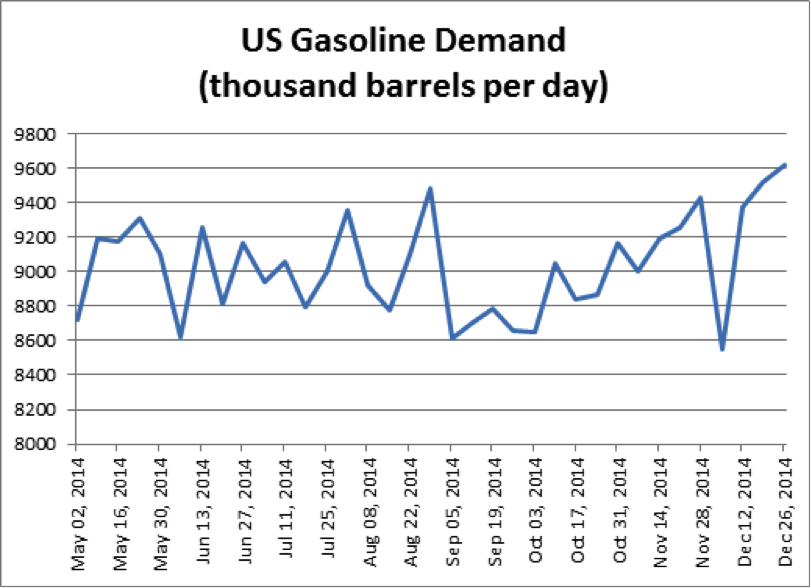
Now drivers are required to include 10 percent ethanol in each gallon of gas. Therefore, ethanol has a fixed market. Driving has been declining in recent years, which is one reason that the Renewable Fuel Standard has been under fire – because the absolute amount of ethanol required has exceeded the 10 percent requirement in relation to the amount of gasoline consumed. Refiners and oil companies must buy this amount of ethanol. This is the reason the Environmental Protection Agency has been holding back on setting an RFS for 2014 — because the original amount prescribed was going to exceed the 10 percent figure. If people start taking advantage of lower gas prices and start consuming more gasoline, the amount of ethanol required will grow. “(W)e should be seeing a 2+% increase in gasoline demand, and that will take some pressure off the ethanol blend wall,” Lane writes. It might make EPA’s decision easier, if it ever gets around to setting a number.
Just to emphasize this point, an RIN — Renewable Index Number — is required by the EPA to prove that a refinery has been adding ethanol up to the 10 percent mark. The price of RINs has actually been rising as gas prices have fallen. As Lane writes: “Part of the reason that the ethanol market is holding up relatively well in tough times is the impact of the Renewable Fuel Standard, and its traded RIN system. RIN prices have jumped as oil prices have slumped — and a $0.76 increase in the RIN value of a gallon of fuel is a striking increase in value.”
So all is not dark for the future of alternatives. Ethanol’s place is secure, despite the fall in gasoline prices. Remember, it’s not that demand for gas is falling, but people are spending less for what they get. If methanol is given a chance, it might turn out to be more invulnerable, since it’s not tied to corn prices but to natural gas, which we seem to have in even greater abundance than oil. Electric cars also don’t lose their appeal, since much of their appeal is getting off gas entirely and unbuckling from the oil companies. It may not be time to abandon your stock in alternative energies quite yet.

BusinessWeek’s Matthew Phillips reflects on the EPA’s decision to delay proposed changes to the renewable fuel standard, a revision that was expected to reduce the amount of corn-based ethanol to be blended into the nation’s gasoline supply.
Now that the new RFS standards have been put off until sometime in 2015, ethanol producers have the chance to regroup and fight another day, Phillips writes.
The ethanol industry just avoided a death blow. Rather than deciding to permanently lower the amount of renewable fuels that have to be blended into the U.S. gasoline supply, as it first proposed a year ago, the Environmental Protection Agency last week opted to wait until next year to decide. The delay (official notice here) means this year’s ethanol quotas won’t be set until 2015 and ensures they will be lower than the original mandate envisioned. That’s not great news for ethanol producers, but it gives them more time to fight and avoids an outcome that could have been far worse.
…
Ethanol industry leaders pretended to be angry at the EPA’s decision to delay on Friday: “Deciding not to decide is not a decision,” Bob Dinneen, chief executive of the Renewable Fuels Association, said in a written statement. But the reality is that they’re relieved the White House didn’t choose a more aggressive plan pushed by refining and oil companies.
The federal government’s new threshold for the amount of ethanol blended into America’s gasoline supply was already 10 months overdue. So officials have gone ahead and delayed the decision further, into 2015.
The Environmental Protection Agency announced Friday that it would defer an announcement on the renewable fuel standard (RFS), which stipulates that ethanol should make up 10 percent of gasoline.
(The Des Moines Register has some of the day’s best reporting on this issue. Agriculture.com also has a good explanation of the granular details.)
The standard, first established under a 2005 law, calls for the amount of renewable fuels in gasoline to progressively increase each year. But the law was written at a time when demand for gasoline was expected to keep going up. Slackened demand around the world, combined with stepped-up U.S. production, has dropped domestic prices below $3 a gallon.
Based on that reality, the EPA recommended, in November 2013, that the amount of corn ethanol in the should be reduced, from 14.4 billion gallons a year to 13.01 billion gallons.
This upset the corn growers and ethanol producers, most of them clustered in the Midwest and Great Plains. They said the delays deterred investment in biofuels, and even the oil companies complained that the regulatory vacuum created too much uncertainty in the fuels market.
The EPA’s recommendations had not been finalized. They had been sent to the White House Office of Budget and Management for review, but that office “ran out the 90-day clock to review the agency’s proposed standards, which for the first time signaled a retreat by the EPA on the percentage of biofuels that must be blended,” The Hill reported.
Since the EPA was already so late in setting the 2014 guidelines, the agency “intends to get back on track next year, though details on how it would do that weren’t available Friday,” The Wall Street Journal wrote. The EPA statement said: “Looking forward, one of EPA’s objectives is to get back on the annual statutory timeline by addressing 2014, 2015, and 2016 standards in the next calendar year.”
The reaction among the affected parties was mixed Friday. The WSJ tries to untangle the various interests:
The debate over the biofuels mandate triggers strange bedfellows, with trade groups representing the oil and refining companies, car manufacturers, livestock and even some environmental interests all opposed to the policy for different reasons. Proponents of the standard include the corn industry, which is the most common way ethanol is produced, and producers of ethanol.
The EPA’s announcement gave cautious hope to ethanol-industry leaders that the agency will fundamentally rethink how it proposes the annual biofuels levels. The draft 2014 biofuels levels, which the agency proposed almost a year ago, were much lower than the ethanol industry lobbied for.
“I am truly pleased that they’re pulling away from a rule that was so bad,” said Bob Dinneen, president and CEO of the Renewable Fuels Association, a trade group representing biofuels companies. “But I recognize as well we have to work with the agency to try to figure out a path forward that everybody can live with.”
Executives in the oil-refining industry criticized the delay, and said it was evidence the renewable-fuel standard was itself inherently flawed and should be repealed.
“Each year is dependent upon the previous year, and to some extent dependent upon the following year,” said Charlie Drevna, president of the American Fuel & Petrochemical Manufacturers, a trade association representing the nation’s refining industry. “The problem is, every year EPA is late in getting this out, it exacerbates it. They’re never going to be able to catch up.”
Nebraska is the nation’s third-leading corn producer (behind Iowa and Illinois), and it’s also fertile ground for the ethanol industry.
As the state Department of Agriculture notes, Nebraska has 25 operating ethanol plants that produce more than 1.2 billion gallons of ethanol a year. These operations employ about 3,000 people.
So it’s no surprise that Nebraskans are ahead of much of the nation when it comes to adopting ethanol as a transportation fuel. There are 67 stations in the state where E85 (a blend of up to 85 percent ethanol and the rest traditional gasoline) is available, according to the Alternative Fuels Data Center.
About 10 percent of Nebraskans drive a vehicle that is branded flex-fuel, with the tell-tale badge on the rear or a yellow gas cap, meaning it can run any ethanol concentration (including E85) or gasoline or any blend of the two. The benefits of running E85 in a flex-fuel vehicle are numerous: It’s often cheaper than regular gas, even when you account for the roughly 30 percent reduction in fuel economy compared with gas; ethanol produces less toxic pollutants that harm health, and fewer greenhouse-gas emissions that harm the environment. The vehicle’s engine also has more power and better performance on ethanol.
In a story in the Grand Island Independent by Robert Pore this week, Gov. Dave Heineman encouraged Nebraskans who own flex-fuel vehicles to support the state’s ethanol industry, and take advantage of a renewable resource grown locally, by filling up with E85. “E85 continues to gain popularity across our state and country – allowing us to continue to reduce our dependence on foreign oil,” Heineman said.
Nebraskans will have the opportunity to learn more about ethanol and other replacement fuels during a free screening of the Fuel Freedom Foundation-produced documentary “PUMP” on Nov. 12 on the University of Nebraska campus in Lincoln. The film will be shown at 7 p.m. at the Mary Riepma Ross Media Arts Center, 313 N. 13th Street. As this calendar notice on the Lincoln Journal Star website notes, the screening will be hosted by the Nebraska Ethanol Board, the Urban Air Initiative and the Association of Nebraska Ethanol Producers. After the film, Doug Durante, executive director of the Clean Fuels Development Coalition, will lead a brief panel discussion and take questions from the audience.
“PUMP” is playing in theaters in several other cities, including Anchorage and Tucson. Visit PUMPTheMovie.com for more information.
While the debate rages about what the threshold for biofuels should be in the government’s next (and long-delayed) Renewable Fuel Standard, Breaking Energy’s Jared Anderson has a timely post about the makeup of the current RFS, as it was proposed by the EPA last November.
There are thresholds within the larger thresholds, and it looks like the cellulosic ethanol target will go down. But as Anderson notes:
“While the battle over the RFS continues, the cellulosic ethanol industry took a major step forward today with the inauguration of a commercial-scale plant in Hugoton, Kansas. The biorefinery has the capacity to produce 25 million gallons of cellulosic ethanol per year, which alone exceeds EPA’s proposed 17 mm gallon blending target under RFS. The plant also generates 25 MW of electricity, which supplies its own needs and provides excess power to the local community.”
Anderson signs off with:
“The RFS will remain controversial, but this new plant is a big win for the cellulosic ethanol portion of the equation.”
(Photo credit: Shutterstock)